Dawn by Octavia E. Butler: A Review
I've loved Octavia Butler so deeply for so long, that it's hard now for me to imagine a world before I knew her. In my freshman year writing class, we read Parable of the Sower and it rattled me to the core. Not that prescience is the most important thing in a work of speculative fiction, but I was nevertheless astonished by how closely this world she imagined looked like the world of today. Being from Southern California, too, and recognizing the places her characters moved through, seeing a landscape I knew through an unfamiliar lens, was astonishing. I couldn't get enough.
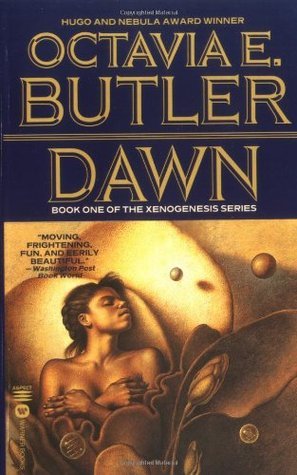
I wish I could remember when, exactly, I found Dawn, because I read almost everything else she ever wrote in such quick succession after that. All I'm missing now is Survivor (pulled from the shelves not long after publication because she hated it so much, so it may be a long time before I rectify that) and Patternmaster (easily acquired, but by now I've put it off so long, I'm almost afraid to begin—it's the last mystery of hers that remains to me, it seems like I should wait for the perfect moment).
Dawn stood out to me among all Butler's work for its refusal to be like anything else I'd ever read. Its disavowal of the kinds of narrative structures I was familiar with, and its plot which, rather than building linearly, seems to meander, spiral, and explode. I also love it for how impossible it seems to adapt to pop-cultural palatability, with its tendrils and tentacles, alien sex and forced evolutions, its sensuality and rootedness in enfleshment, embodiment, ensoulment; the way it asks uncomfortable, impossible to answer questions about the meaning of difference, the meaning of humanity, what separates one human from another, one species from another, one mind from another. Ava Duvernay is reportedly adapting the books into a television series, and while I eagerly await its release, I can't help but feel that Dawn is a story too much about the things humans fear to make for successful television—though I certainly hope to be proven wrong!
The Lilith's Brood (or Xenogenesis) series is excellent all the way through, but Dawn holds a special place in my heart—the first of its kind I had ever read, and the beginning of something as deeply special, complicated, and entirely unique as the new humanity that Lilith finds herself the progenitor of.
the story
Lilith is a young Black woman who wakes up in a strange room with no idea where she is and no memory of how she got there. Her needs are met and she's taken care of by a mysterious entity she can't quite identify, but she is not allowed to leave. Eventually, this entity reveals itself to be a member of the Oankali, an alien species that has swooped in just as humanity was about to destroy itself in a nuclear apocalypse, and rescued its few survivors. Lilith is now one of only a few human beings who remain, and she has been chosen, due to her genetic history and personality archetype, to help usher in a new era of community between the two species.
The Oankali are highly intelligent and different from humans in just about every possible way: covered in tentacles with no discernable facial features, and a mating structure completely foreign to Lilith. The Oankali have three sexes (male, female, and ooloi), and their family units include one parent of each sex, with the males and females usually being a sibling pair. Ooloi use the neuter pronoun (it/its) and use specially-designed limbs to facilitate the exchange of both genetic material and emotional intelligence between its partners, feeling what they're feeling and creating new sensations in those it touches.
The story follows Lilith as she comes to terms with her new position as one of the last members of an endangered species, and develops a connection with both Nikanj, an ooloi, and Joseph, a human man who was also spared from Earth's destruction. The Oankali are genetic traders, and have crossed the galaxy collecting the best adaptations that other species have to offer in an effort to be constantly growing and adapting. Their spaceship itself is a distant ancestor, a living being with whom the Oankali traded genetics to help facilitate their endless evolution. Lilith soon learns that the Oankali wish to exchange genetics with humans next, and hope to evolve yet again to integrate the greatest genetic gift humans have to offer: the propensity for cancer, which, when edited by ooloi geneticists, allows the species almost limitless potential for adaptability and change. Lilith is tasked with the job of convincing humans to accept this trade and take up relations with Oankali families, ushering in a new species of human-Oankali hybrids. Both human and Oankali as they currently are will cease to exist, they say, and this hybridization will be their future.
The plot itself is relatively spare. It's a fairly short book, and for an "alien invasion" story, there's little action, and most of the explicit acts of violence happen off-page. And yet, the story is rich with thematic implications and difficult conversations that Butler refuses to shy away from. The human taboos against incest, prejudices against intersex bodies, anxieties about sexuality, hazy boundaries around consent and coercion, processes of racial formation, the ways that identity and history undeniably alter what it means to be human—these topics often make for an uneasy reading experience. Readers may find themselves reaching for some simple answer, some straightforward villain to point to. Butler denies us this moral simplicity, opting instead to weave a tight knot of power, affection, social obligation, and biological impulse which can't be easily untwined. There are humans who accept the Oankali and those who refuse their offer, and some from each group resort to violence. The boundaries of identity become porous, as the elements which previously defined human experiences—class, gender, race, sexuality, body type—become radically reorganized and redefined. It is significant that Lilith, the mother of this new "brood" (as the later rerelease of the series terms it) is a Black woman. Many human survivors target her with racial and sexual violence, calling into question her very humanity, even as she works to preserve human self-determination against Oankali notions of unity.
In the face of these historical violences that (some) humans seem to be unable to stop committing, even after being destroyed by them, the transformation and peace that the Oankali might seem to have its allure. What's so wrong with becoming something different? With discarding the human and all the baggage that being human has carried? But "transcending" humanity has very different connotations to Lilith, a Black woman whose humanity has already been denied again and again, even before aliens arrived. In the words of Tiffany Lethabo King, Lilith's refusal speaks to just how "perverse and reprehensible it is to ask Indigenous and Black people who cannot seem to escape death to move beyond the human or the desire to be human" ("Humans Involved: Lurking in the Lines of Posthumanist Flight," 167). For the Oankali, change and symbiosis are critical to their identity as a people. For Black humans, "change" has so often meant rupture, and "symbiosis" has meant "parasitism."
Dawn is a book that calls into question the ideas that writers and theorists like Sylvia Wynter, Zakiyyah Iman Jackson, Donna Haraway, and so many others have explored through their critical work, asking and answering with as much clarity as any academic analysis: What does it mean to be human? Who is denied access to the label, and who has the power to bestow it on and strip it from others? Already, equal access to humanity is not granted to all homo-sapiens on planet Earth: this much Butler takes as understood. But this story asks what happens when the necessary qualifications for the label are changed yet again, when the context is moved off of Earth, to a place free of Earth's existing structures of power. Her answer seems to be that the power and hierarchy that humans have created cannot be so easily destroyed as the human beings themselves.
Even as Lilith's agency is stripped from her, as her trust is betrayed by the Oankali she's most come to love and depend on, Lilith refuses to hate these alien others the way so many other humans have. What's done cannot be undone, she seems to say. Violence cannot be erased and power cannot be dissolved entirely. But for this new species they will make together to survive, a new shape will need to be made out of the relationship between humans and Oankali. A real respect, a sacrifice of both pride and individuality. Violence and harm are realities, yes, both historically and in the present, but they don't have to define the future. It's a bleak kind of optimism, but one that considers the realities of power—that even when it can't be destroyed, perhaps it can be remade to serve other ends.
the legacy
I feel fortunate to have been introduced to Dawn when I was, as a college student beginning to question my own role in power and powerlessness, beginning to recognize the systems and structures I benefitted from and was marginalized by. It's a book that opened my eyes to science fiction as a philosophical exercise, as a way of working through complex issues beyond the thin veneer of "allegory," which sought to find and replace a real marginalized group with an imagined one. Butler's storytelling was always Both And. There is an imaginary power struggle, and meanwhile the existing ones carry on as ever. How do they inform each other? Change each other? Challenge each other?
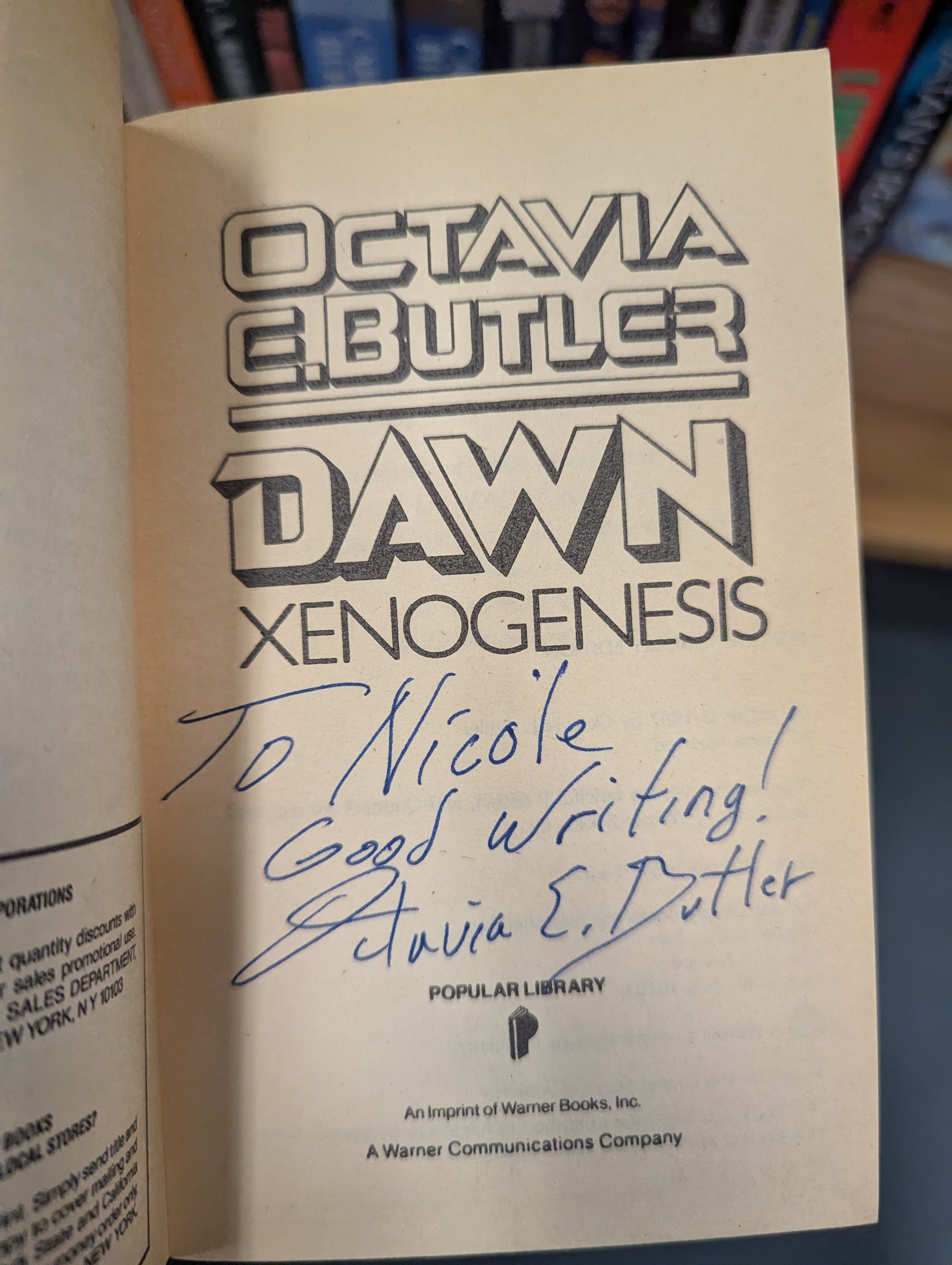
I found a signed copy of the book recently, by surprise and for just $4 in a used bookstore—I imagine the sellers had no idea what was on the title page, and I didn't tell them. I pick it up every once in a while, carefully, to look at the signature, envious of the mysterious Nicole who met Octavia Butler and earned her admiration, wishing I could have had the same chance. As I finish writing this, it's been 20 years to the day since she died. I can't believe the tragedy of it sometimes; how much she gave us, how much she had left to say, how badly the world needed and still needs her. But looking at her signature on that page, I remind myself too of how fortunate we all were to have had her. To have borne witness to her determination in asking the unanswerable, and to feel the warmth now of the new suns she threw into the sky.